


Legal Update
Sep 11, 2026
Employment Rights Act 2025
UK employment law reform: the next phase
UK employment law is undergoing one of its most significant periods of reform in decades. The Employment Rights Act 2025 introduces a broad programme of changes intended to strengthen employment protections and modernise workplace rights and industrial relations.
The changes are being implemented in phases throughout 2026 and 2027 and affect most stages of the employment relationship, from family leave and sickness absence to workplace disputes and dismissal. Several reforms have already taken effect, with the next tranche of changes due in October 2026.
October 2026 changes
From 1 October 2026, the time limit for employees bringing most Employment Tribunal claims will increase from three to six months.
This will be followed on 30 October 2026 by changes to workplace harassment obligations and a package of trade union reforms:
- Workplace harassment
Employers will be required to take ‘all reasonable steps’ to prevent sexual harassment in the workplace, rather than simply ‘reasonable steps.’ Employers will also have a new duty to prevent harassment by third parties, for example, by clients and customers. Employers should review their risk assessments, policies, and training to ensure appropriate preventative measures are in place.
- Trade union rights
Employers will be required to inform workers in writing of their right to join a trade union, whether or not the workplace is unionised. The requirement is to provide this statement at the same time as employees are provided with their employment contracts. Employers should therefore review their contract and onboarding documentation once the requirements have been confirmed; detailed guidance is expected shortly. Trade unions will also gain new rights to request physical or digital workplace access. This could be significant, particularly for some larger employers that are not currently unionised, as access requests cannot simply be disregarded. There are also wider reforms aimed at strengthening the union recognition process and providing greater protection for union representatives and workers taking industrial action.
Changes already in force
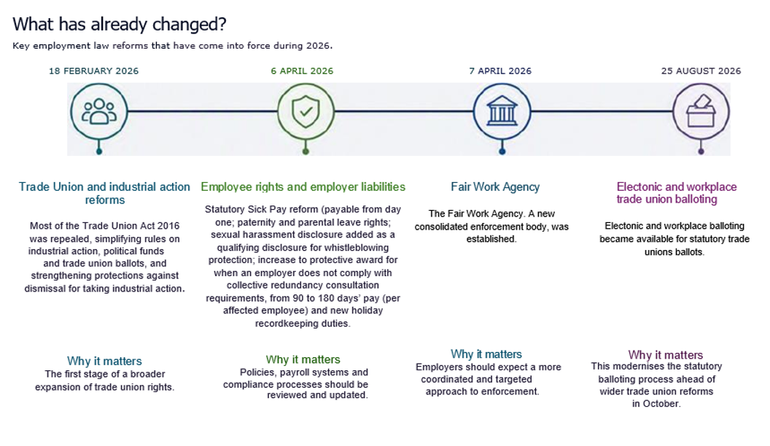
The first wave of reforms has already taken effect during 2026, including changes to Statutory Sick Pay, family leave, whistleblower protection, collective redundancy liability, and holiday recordkeeping. The timeline below provides a brief overview of the key changes and their practical significance for employers.
Important 2027 changes
Further changes are planned for 2027, including significant reforms to unfair dismissal protection from January 2027.
From 1 January 2027, the qualifying period for employees to acquire ordinary unfair dismissal protection will reduce from two years to just six months. Any employee with at least six months’ service on that date will acquire protection immediately. The existing cap on compensatory awards for unfair dismissal, currently the lower of 52 weeks’ gross pay or £123,543, will also be removed. Compensation will remain based on the employee’s actual and projected financial losses, but there will no longer be a statutory ceiling on the amount that may be awarded. This will have a significant impact on settlement negotiations and litigation strategy, particularly in relation to higher earners.
This represents a significant change to the existing regime and will increase the importance of managing performance, conduct and capability concerns at an early stage. Employers should also consider the impact on probationary processes and fixed-term contracts.
A number of other important reforms are also planned for 2027. Restrictions on “fire and rehire” are confirmed for January 2027, while further reforms are expected later in the year, including new rights for zero-hours and low-hours workers, changes to collective redundancy consultation and flexible working, and enhanced dismissal protections for pregnant employees and new mothers. Much of the detail and timing of those wider reforms remains subject to further regulations and consultation. We will provide further updates nearer the time, with more detail on these changes and the steps employers should consider taking to prepare.
Seyfarth Shaw LLP provides this information as a service to clients and other friends for educational purposes only. It should not be construed or relied on as legal advice or to create a lawyer-client relationship. Readers should not act upon this information without seeking advice from their professional advisers.