


Legal Update
Sep 21, 2025
Sticker Shock for H-1Bs: Presidential Proclamation Disrupts Employer Landscape
Seyfarth Synopsis: On September 19, 2025, President Trump issued a Presidential Proclamation, Restriction on Entry of Certain Nonimmigrant Workers, announcing limitations on certain H-1B employees. Notably, the Proclamation announced a required $100,000 payment for new H-1B petitions filed on or after September 21. The Proclamation is part of a broader government initiative to reform the immigration system, prioritize high-skilled and high-paid foreign talent, and safeguard U.S. labor markets. Although the language of the Proclamation was subject to varying interpretations, the Department of Homeland Security (DHS) subsequently clarified certain provisions.
Key Takeaways for Employers
While the language in the proclamation appeared to indicated otherwise, clarifying guidance that was issued by U.S. Citizenship & Immigration Services, as well as U.S. Customs and Border Protection (along with statements from Administration officials) note the following:
- There is no impact to the employment of existing H-1B employees. Likewise, there is no impact to the employment of individuals with pending H-1B petitions that were filed on or before September 20, 2025 (including all 2025 H-1B quota petitions).
- Individuals with pending or approved H-1B petitions that are currently abroad (or who intend to travel internationally in the future) should not be subject to any additional travel restrictions. Similarly, these individuals should not experience any change to the H-1B visa process at U.S. Consulates abroad (i.e. obtaining a travel document to enter the United States).
- Employers filing H-1B petitions that request an extension of stay, change of employer, or amendment to current terms of employment should not be required to pay the new fee. The employment continuity of existing H-1B employees should not be impacted.
Looking Ahead
The Proclamation will face legal challenges. Immigration lawyers and other industry stakeholders have raised concerns that the Proclamation effectively amends the Immigration and Nationality Act, thereby overstepping Congressional authority. It is also not clear how the Proclamation aligns with existing legal framework that only authorizes the government to impose fees related to the costs of administering immigration benefit programs.
There is some uncertainty about the precise scope of H-1B petitions that will be subject to the new filing fee, and additional guidance is anticipated. Although this is an evolving situation, current indications are that the fee may apply to 2026 H-1B quota petitions for individuals who are outside the U.S. (foreign nationals that are present in the U.S. in another visa classification would seemingly be exempt from the fee). There is also a lingering question regarding employers who are exempt from the H-1B quota, such as public and nonprofit institutions of higher education and nonprofits affiliated with a qualifying organization – initial litigation is expected to focus on this specific topic.
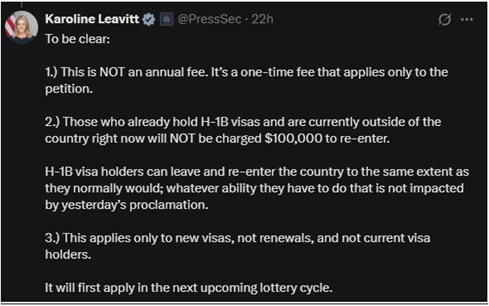
We also expect further clarification from DHS, unpacking other areas of the proclamation including the cadence and payment mechanism of the $100,000 fee. The White House appears to be engaged with industry groups, employers and others on the impact of the proclamation. On Saturday evening, Press Secretary Karoline Leavitt posted the following on X:
Other Provisions
Although the principal focus of the Proclamation concerned the $100,000 fee payment and potential travel limitations, the Proclamation also:
- Directs the Secretary of State to issue guidance to prevent “misuse of B visas” by individuals with approved H-1B petitions;
- Authorizes the government to exempt the fee payment for all individuals working within a specific industry or for a specific company, provided such exemption is in the national interest; and
- Directs the Secretary of Labor to initiate rulemaking to “revise the prevailing wage levels [utilized in support of H-1B petitions] to levels consistent with the policy goals” of the Proclamation.
Subject to further government clarification and the outcome of expected litigation, the Proclamation has the potential to alter the framework for the recruitment and hiring of foreign talent that resides abroad. Employers are encouraged to consult with immigration counsel to assess potential risks and strategy. Employees should also check with their employers regarding any upcoming travel, as circumstances may change without notice. The initial rollout of this Proclamation created significant confusion (until further clarification was issued), highlighting the fluid nature of these developments.
Seyfarth Shaw LLP provides this information as a service to clients and other friends for educational purposes only. It should not be construed or relied on as legal advice or to create a lawyer-client relationship. Readers should not act upon this information without seeking advice from their professional advisers.
