


Legal Update
Sep 18, 2026
Beyond HR: Non-Financial Misconduct as an FCA Regulatory Responsibility
A workplace complaint raised through a global hotline or U.S.-led investigation may now require separate UK Conduct Rules and fitness and propriety assessments under the FCA’s new guidance.
The UK Financial Conduct Authority, ("FCA"), has issued its first dedicated Handbook guidance on the application of the Conduct Rules and fitness and propriety framework to non-financial misconduct. The guidance applies across banks and non-banks. A separate rule change expands the scope of the Conduct Rules for non-bank firms. Both took effect on September 1, 2026.
For U.S.-headquartered financial services organizations, a concern reported through a global hotline or investigated by U.S. HR and Legal may also require assessment by the FCA-regulated UK business. A matter that begins as an employee relations issue may therefore require early input from UK HR, Legal and Compliance, separate employment and regulatory assessments, and consideration of reporting and certification implications.
For non-banks, the rule change expands the types of work-related misconduct that may fall within the Conduct Rules. For banks and non-banks, the guidance provides a common framework for applying the Conduct Rules and fitness and propriety requirements to non-financial misconduct. However, it does not remove the need for case-specific judgments about seriousness, the boundary between work and private life, and the treatment of unresolved allegations.
What is non-financial misconduct?
Non-financial misconduct, or NFM, is a broad term for misconduct that is not clearly financial in nature. The new guidance focuses principally on bullying, harassment and violence, although other conduct, including discrimination, retaliation, misuse of authority and relevant conduct in private life, may also have regulatory significance depending on the circumstances.
Not every instance of poor behavior will have regulatory significance. An insensitive comment, management dispute or breach of company policy does not automatically become a Conduct Rule breach.
The assessment may depend on the seriousness and impact of the behavior, whether it was repeated, whether authority was misused and how closely the conduct was connected to the individual’s role. The individual’s regulatory status and the nature, timing and context of the conduct may also be relevant.
Getting the investigation and decision-making framework right
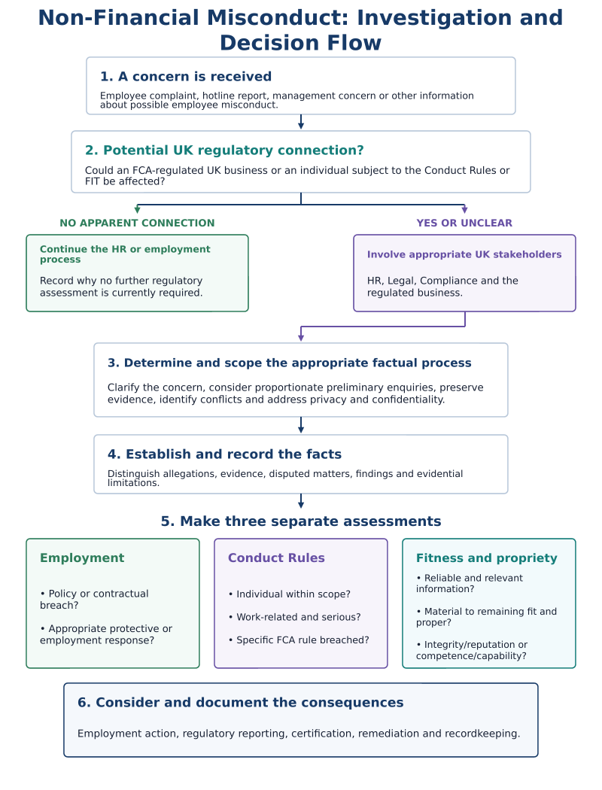
1. Identify the UK regulatory connection early
A complaint may be reported through a U.S.-managed hotline, global HR or a manager outside the UK and initially appear to be a conventional employee relations matter. If it affects an FCA-regulated UK business or someone subject to the Conduct Rules or fitness and propriety requirements, it may also need regulatory assessment.
Organizations may therefore wish to check whether their global reporting and intake processes identify a potential UK connection early enough to involve the appropriate HR, Legal, Compliance and regulated-business stakeholders.
2. One process to inform three separate assessments
A coordinated factual process may establish the relevant facts, after which the organization may need to make three distinct assessments:
- Employment: Was company policy or a contractual standard breached, and what response is appropriate?
- Conduct Rules: Is the individual within scope, is the conduct sufficiently work-related and serious, and does it breach a specific FCA rule?
- Fitness and propriety: Is there sufficiently reliable and relevant information that is material to whether the individual remains fit and proper?
These assessments apply different tests and may produce different answers. An upheld complaint or termination, including for gross misconduct, does not automatically establish a Conduct Rule breach. Conduct outside the Conduct Rules may nevertheless be relevant to fitness and propriety.
The factual investigation should distinguish allegations, evidence and findings. Responsibility for the employment, Conduct Rules and fitness and propriety decisions should remain clear and appropriately separated.
3. Apply the UK tests to global findings
A global investigation may establish the facts, but its findings must still be considered under the applicable UK employment and regulatory tests.
For example, “harassment” under the Conduct Rules is not limited to unlawful harassment related to a protected characteristic, and an internal “business conduct violation” does not automatically establish an FCA breach.
How might the framework apply in practice?
An employee complaint
An employee alleges that a senior colleague repeatedly humiliated them during team meetings and sent intimidating messages afterward.
The factual investigation may be coordinated globally. The UK-regulated firm may then need to consider separately whether company policy was breached, whether the conduct falls within and breaches the Conduct Rules, and whether the findings affect fitness and propriety.
When an “unsubstantiated” HR outcome may not determine the regulatory assessment
An unsubstantiated HR complaint does not necessarily determine the separate fitness and propriety assessment. Depending on the circumstances, the firm may still need to consider any sufficiently reliable and relevant information without treating unresolved allegations as facts.
Repetition alone does not make reports reliable. Their independence, specificity, consistency, available supporting information and the individual’s response may all be relevant. The record should distinguish established facts from unresolved concerns and explain any evidential limitations, including witness reluctance.
Conduct outside the usual workplace
Conduct outside the office, including at work-related social events or in private messages between colleagues, may still fall within the Conduct Rules depending on its connection to the individuals’ roles. Even if it falls outside the Conduct Rules, it may remain relevant to fitness and propriety.
Routine monitoring is not required, but a firm may consider whether a targeted review is appropriate where a specific concern arises, subject to applicable privacy, employment and other legal requirements.
Practical decision flow
Practical takeaway
The new framework means that employee matters with a potential UK regulatory connection cannot always be handled as self-contained HR exercises. Firms may need to identify the regulatory implications early and coordinate input from global and UK HR, Legal, Compliance, workplace investigators and the FCA-regulated UK business.
Combining investigations, employment and FCA regulatory experience can help establish a reliable factual record while preserving the separation between the factual process and the subsequent decisions. Each assessment should be made under the correct test and by the appropriate decision-maker.
Seyfarth Shaw LLP provides this information as a service to clients and other friends for educational purposes only. It should not be construed or relied on as legal advice or to create a lawyer-client relationship. Readers should not act upon this information without seeking advice from their professional advisers.