


Legal Update
Jan 28, 2026
Washington Employment Class Actions Are Surging: What Employers Need to Know
Over the past several years, Washington has experienced a surge in employment-related class action filings. Class actions have been filed against employers of every size, in every sector, and across every region of the state.
A Dramatic Rise in Filings
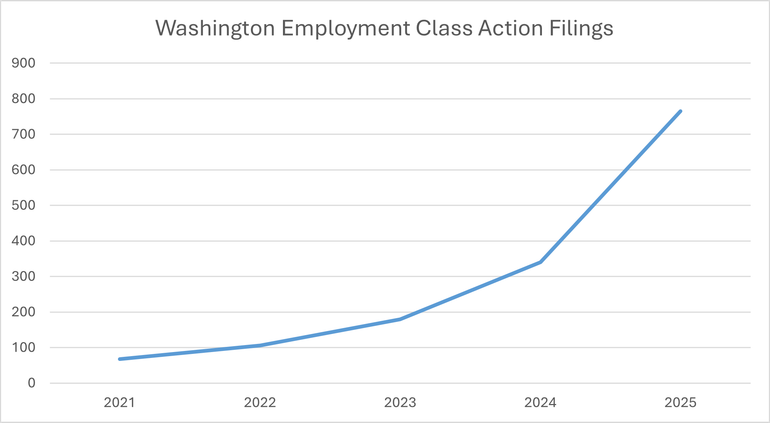
According to publicly available litigation data[1], the volume of employment class action filings has skyrocketed over the past five years. In 2021, plaintiffs filed approximately 68 employment class actions across the state. In 2022, that number rose to just over 100. In 2025, Washington saw around 765 new employment class action filings statewide.
What’s Driving the Spike?
While no one factor can fully explain the surge, the data and recent case filings point to several key drivers.[2]
- A sharp rise in wage and hour litigation, particularly around meal and rest break compliance.
About 32% of 2025 employment class actions included claims that employers failed to provide compliant meal and rest breaks, automatically‑deducted meal periods without confirming breaks were taken, or failed to provide premium pay for missed breaks. These cases span industries—from hospitality and retail to healthcare, manufacturing, and logistics—and affect both large companies and smaller local employers. The 2024 Androckitis v. Virginia Mason Medical Center decision likely had an impact on the number of filings. We wrote about the Androckitis decision here, which endorsed a 30-minute penalty for break violations. The ruling, which is being applied retroactively, took many employers by surprise, as the applicable regulations and guidance were silent about penalties. Many of the class actions target employers who did not historically pay a penalty before Androckitis. - An uptick in EPOA‑related claims.
Another significant driver of the increase in litigation is claims under Washington’s Equal Pay and Opportunities Act (EPOA). Approximately 40% of the cases brought in 2025 included claims challenging job posting practices. A smaller portion of the 2025 employment class actions, 10%, alleged that employers were enforcing unlawful non-competition or restrictions on outside employment. Many of these cases have been brought by a handful of law firms using nearly identical pleadings.
Why Employers Should Take Note
The sheer number of filings is important, but the more telling point is unpredictability and risk exposure. No industry or employer profile is insulated. The recent filings include claims against nonprofit organizations, local service businesses, regional retailers, Fortune 500 companies, and small entities with only a few dozen employees. The absence of an identifiable “safe” profile underscores a core point: compliance or documentation gaps, even unintentional ones, will draw scrutiny regardless of employer size or sector.
Practical Steps for Employers
A few proactive measures can meaningfully reduce risk:
- Conduct a comprehensive wage and hour audit focused on break compliance, timekeeping practices, Androckitis compliance, and overtime calculations.
- Consider arbitration agreements and class action waivers.
- Audit job postings and recruiting processes and policies to ensure compliance with Washington’s wage transparency requirements.
- Evaluate whether any policies or practices inadvertently restrict outside employment, particularly for lower‑wage positions.
- Regularly train frontline managers—even if a company’s policies are compliant, a plaintiff may claim that the implementation of the policy violated the law.
- Update onboarding documents to ensure they do not include outdated non-competition, non-disparagement, or confidentiality provisions.
At base, employers in Washington should be aware that class actions are coming. Employers should proactively review policies, audit their pay practices, and strengthen meal and rest break compliance systems. An investment in preventive measures today is far less costly than the alternative.
[1] These estimates are based on data obtained from Courthouse News Service.
[2] Estimates in this section are based on case summaries collected by Courthouse News Service, which may not accurately reflect all causes of action asserted in each case, and should be understood as directional indicators of filing trends rather than precise measurements.
Seyfarth Shaw LLP provides this information as a service to clients and other friends for educational purposes only. It should not be construed or relied on as legal advice or to create a lawyer-client relationship. Readers should not act upon this information without seeking advice from their professional advisers.