


Legal Update
Apr 15, 2026
Real Estate: Market Pulse (April 2026)
Signs of Stability Emerge Across Key CRE Sectors
Seyfarth’s real estate team provides a bird's-eye view of the current state of commercial real estate throughout the country—highlighting which markets and major asset types are active, slowing down, or experiencing shifts.
Seyfarth’s Take: What to Know
✔ Opportunities: Data centers remain the strongest nationwide opportunity, with continued expansion across Texas, the Midwest, and key coastal markets. Industrial and multifamily are stabilizing in several regions, while retail is showing signs of recovery in urban cores and high-quality corridors. Most markets are seeing improving fundamentals and renewed investor optimism.
✔ Challenges: Office performance remains uneven, with persistent vacancy and reduced valuations continuing to weigh on major markets. Broader economic uncertainty is tempering transaction activity, while policy and regulatory factors, including potential rent control measures in Boston, increased scrutiny of data center development, and infrastructure constraints, are creating additional complexity for investors and developers.
✔ Market Trend: The CRE landscape is entering a more balanced phase, with stabilization across multiple asset classes and renewed momentum in select high-growth markets. Data centers continue to anchor activity, while AI-driven demand is accelerating recovery in tech-centric regions like San Francisco.
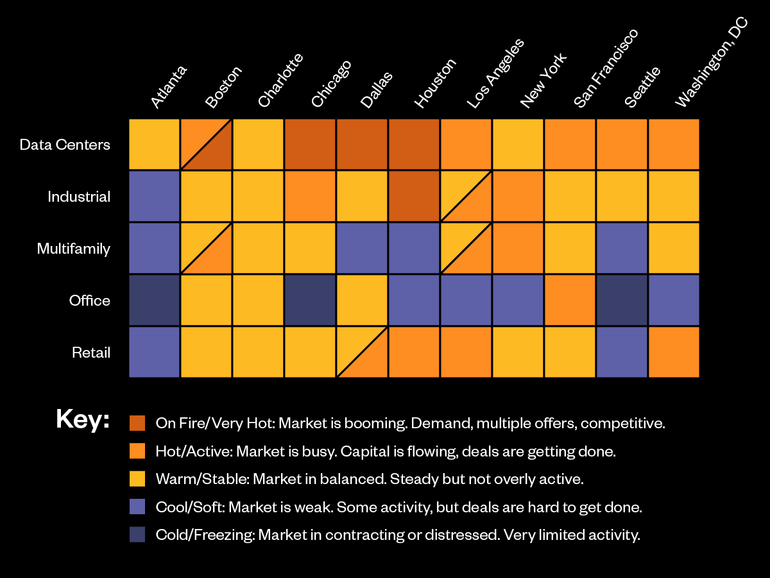
Regional Rundown
"The Atlanta commercial real estate market is trending stable to soft amid ongoing economic uncertainty. Office remains the most challenged sector, while industrial, multifamily, and retail are cooling following a strong run. Data centers continue to stand out as a bright spot, supported by an active development pipeline, though political and civic headwinds are increasing." Kwame Benjamin, Partner
"Strong fundamentals persist in the Boston real estate market. However, a statewide rent control referendum on the November ballot is creating some uncertainty within the real estate and greater business communities, particularly amongst buyers, developers, and investors of multifamily assets." Catherine Burns, Partner and Eric Greenberg, Partner
"Across the Charlotte commercial real estate market, fundamentals remain stable. Multiple asset classes are demonstrating steady absorption and measured growth, supported by diversified demand, disciplined development, and continued population and employment expansion in the region." Eric Sidman, Partner
"The Chicago commercial real estate market is a mixed picture, with very strong demand in data centers and industrial, steady activity in multifamily and retail, and a notably weak office sector that continues to lag." Michael Merar, Partner and Tobi Pinsky, Partner
"The Dallas commercial real estate market entered 2026 with stabilizing fundamentals and continues to be recognized as a top market to watch nationally." Amy Simpson, Partner
"In the Houston area, industrial and retail sectors remain strong, while multifamily is facing oversupply and office continues to experience historically weak conditions. Although energy prices remain a key driver of the local economy, optimism tied to rising oil prices is tempered by uncertainty stemming from policy shifts in Washington, DC." Peter Oxman, Partner
"The Los Angeles commercial real estate market is showing renewed momentum. Data centers remain highly active, while industrial and multifamily are becoming more optimistic, with expectations for rising rents and declining vacancies. Office continues to face challenges, with transaction activity at reduced valuations, though retail sentiment has improved and new development is anticipated for next year." Tim Farahnik, Partner and Stacy Paek, Partner
"The New York commercial real estate market is steady overall, with strong activity in industrial and multifamily, stable performance in data centers and retail, and softer conditions in office." Miles Borden, Partner and Cynthia Mitchell, Partner
"The San Francisco commercial real estate market is experiencing a notable rebound, with improving conditions across multiple asset classes, including office. This momentum is being driven by the growth of the AI sector, a more pro-business local government approach, increased public-private collaboration, and a broader return-to-office push among employers." Robin Freeman, Partner
"In Seattle, data center demand remains strong, the industrial sector has largely stabilized, and multifamily is showing a modest uptick as buyer demand improves. These trends come against the backdrop of challenges posed by hybrid work and consistently high operating costs." Jami Balint, Partner
"Data centers continue to be a key driver in the greater Washington, DC market, though they are facing increased scrutiny from local governments. At the same time, urban core retail is recovering and emerging as a relative strength." James O’Brien, Partner
About Seyfarth's Real Estate Team
Recognized as one of the largest real estate practices in the US, we have built an integrated team that serves local, regional, and national clients on the acquisition, financing, development, leasing, restructuring, servicing, and disposition of noteworthy real estate assets and portfolios. This experience extends across comprehensive array of asset classes, including office, industrial, multifamily, retail, health care, and data center projects. Learn more about our Real Estate practice.
Seyfarth Shaw LLP provides this information as a service to clients and other friends for educational purposes only. It should not be construed or relied on as legal advice or to create a lawyer-client relationship. Readers should not act upon this information without seeking advice from their professional advisers.